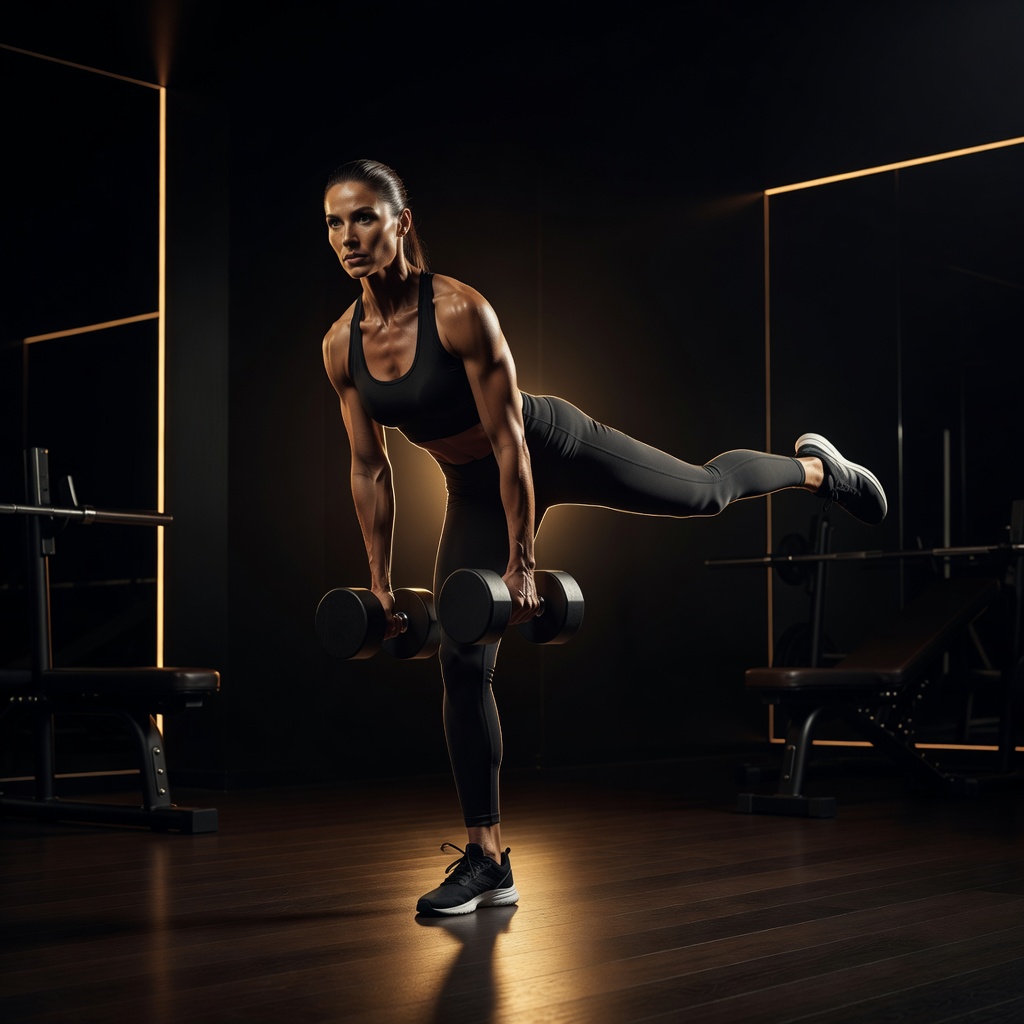
Muscle Is the Organ of Longevity
There is a growing consensus among longevity researchers that the single best predictor of healthspan — the number of years you live well, not just alive — is muscle mass and functional strength. More than cardiovascular fitness. More than weight. More than any biomarker your doctor checks at your annual physical.
For women over 35, this is both the most empowering and the most underutilized piece of health information available. Because while muscle loss is inevitable without intervention, building and maintaining muscle is entirely within your control — at any age.
This is not about aesthetics, though the aesthetic rewards are significant. This is about investing in the physical infrastructure your next 40 years depend on.
What Sarcopenia Is Doing to Your Body Right Now
Sarcopenia is the medical term for age-related muscle loss. It begins in your mid-30s and accelerates significantly after 40, particularly if you're not doing resistance training. Without intervention, women lose 3–8% of their muscle mass per decade — and up to 15% per decade after 60.
Here's what that loss actually means in practical terms:
- Your metabolism slows — muscle tissue burns 6x more calories at rest than fat tissue. Less muscle means a lower resting metabolic rate, making fat gain easier and fat loss harder
- Your bones weaken — muscle contractions during resistance training are the primary stimulus for bone remodeling. Less muscle load means accelerating bone density loss and increasing osteoporosis risk
- Your joints become unstable — muscles are your joints' primary shock absorbers and stabilizers. Weak muscles lead to chronic joint pain, poor posture, and injury risk
- Your hormones shift further — muscle tissue is a key site of glucose uptake and insulin signaling. Less muscle accelerates insulin resistance and metabolic decline
- Your independence erodes — functional strength is what lets you carry groceries, lift grandchildren, travel, and live independently for life
The good news: all of this is reversible. Muscle responds to training at every age.
The 5 Foundational Movement Patterns
Forget the machines. Forget the complicated isolation exercises. Functional strength is built on five primal movement patterns that your body was designed to perform and that translate directly to real-world capability:
1. The Hip Hinge
Deadlifts, Romanian deadlifts, kettlebell swings. The hip hinge is the foundation of posterior chain strength — your glutes, hamstrings, and lower back — and it's the most important pattern for preventing low back pain, protecting your hips, and building the kind of powerful, functional lower body that serves you for life.
2. The Squat
Goblet squats, barbell back squats, split squats. Squatting trains your quads, glutes, hamstrings, and core simultaneously. It mirrors the fundamental human movement of sitting and standing — and your ability to squat with full range of motion is one of the most accurate predictors of longevity in older adults.
3. The Push
Push-ups, overhead press, dumbbell chest press. Pushing movements develop your chest, shoulders, and triceps while building the upper body strength and shoulder stability that prevents the postural decline — rounded shoulders, forward head — that characterizes sedentary aging.
4. The Pull
Rows, lat pulldowns, face pulls, chin-ups. Pulling movements are the antidote to a desk-bound culture. They build your back, rear deltoids, and biceps, correct postural imbalances, and are essential for the strong, upright posture that signals vitality at any age.
5. The Carry
Farmer's carries, suitcase carries, waiter walks. Loaded carries build total-body stability, grip strength, core endurance, and real-world functional capacity. They are the most underrated exercises in women's training.
Progressive Overload: The Principle That Makes Everything Work
Progressive overload is the fundamental principle of strength development: your body adapts to the demands you place on it, so those demands must gradually increase over time. This doesn't mean adding weight every session — it means systematically making training more challenging through increased load, volume, density, or complexity.
The mistake most women make is treating strength training like cardio — working at the same intensity, with the same weights, for the same reps, week after week. This produces maintenance at best and stagnation at worst. Your body adapts within 4–6 weeks and stops changing unless the stimulus changes.
A simple progressive overload structure for beginners: Start with 3 sets of 10–12 reps at a weight where the last 2 reps are genuinely challenging. When you can complete all sets and reps with good form, add 2.5–5 pounds and begin again. This simple progression, sustained over months and years, produces extraordinary results.
Training Around Your Cycle
One of the most powerful — and most ignored — tools available to women is cycle-synced training. Your hormonal environment changes dramatically across your menstrual cycle, and your training can be optimized to work with those changes rather than against them.
- Follicular phase (Days 1–14): Rising estrogen and testosterone support strength, power, and muscle building. This is your prime window for your heaviest lifts and most intense training
- Ovulatory phase (Days 12–16): Peak estrogen means peak performance. Hit personal records here — but be aware of increased ligament laxity (estrogen makes connective tissue more flexible) and train with attention to joint alignment
- Luteal phase (Days 15–28): Rising progesterone increases body temperature and perceived effort. Shift toward moderate-intensity strength work, more rest between sets, and emphasize recovery
- Menstrual phase (Days 1–5): Honor fatigue. Light movement, mobility work, and walking are sufficient. Forcing intense training through menstruation elevates cortisol and disrupts recovery
Joint-Safe Training Protocols
Training smart means protecting the joints that will carry you for decades. Several principles are non-negotiable:
- Warm up properly — 10 minutes of dynamic mobility work before every training session. Cold muscles and stiff joints are an injury waiting to happen
- Master form before adding load — ego-driven lifting with poor mechanics is the primary source of training injuries in women over 35
- Prioritize posterior chain — most women are quad-dominant and have underactive glutes. Consciously building your posterior chain protects your knees, hips, and lower back
- Train 2–4 days per week — more is not better. Two to three well-designed sessions per week produces results comparable to five sessions with a fraction of the joint stress and recovery demand
Your Starting Point
If you haven't trained before or are returning after a long break, start here: two full-body strength sessions per week, built around the five foundational patterns, at a manageable weight, for 8–12 reps per set. Focus entirely on learning the movements. After 4 weeks, add a third session. After 8 weeks, begin progressive overload in earnest.
The transformation won't happen overnight. But it will happen. And once you feel what a strong body feels like — the energy, the confidence, the physical ease — you'll never go back.
This is Pillar 2 of The Vitality Method. Explore the full 6-pillar system at coreandcapital.com/vitality-method.
Your Next Chapter Starts Now
Ready to optimize your body and multiply your wealth? Take our diagnostic quiz to get your personalized growth roadmap.
Start Your Transformation